It is safe to say that the headliner of a UFC card is usually the fight that gets fans to open their wallets. An undercard can be stacked or underwhelming, but the main event is typically the biggest reason fans are willing to spend their hard-earned money on a pay-per-view. With the UFC running monthly numbered events since 2006, however, not every headliner has lived up to those lofty expectations. UFC 332 appears to be one such case.
- UFC 332 Gets Sandwiched Between Two Banger-Numbered Events
- Where Does UFC 332’s Main Event Rank Among the UFC’s Worst Ever?
- 1. Anderson Silva vs. Travis Lutter (UFC 67)
- 2. Andrei Arlovski vs. Justin Eilers (UFC 53)
- 3. Amanda Nunes vs. Raquel Pennington (UFC 224)
- 4. Holly Holm vs. Germaine de Randamie (UFC 208)
- 5. Demetrious Johnson vs. Chris Cariaso (UFC 178)
- 6. Rich Franklin vs. Yushin Okami (UFC 72)
- 7- Max Holloway vs. Conor McGregor 2 (UFC 329)
- So, Where Does UFC 332 Rank?
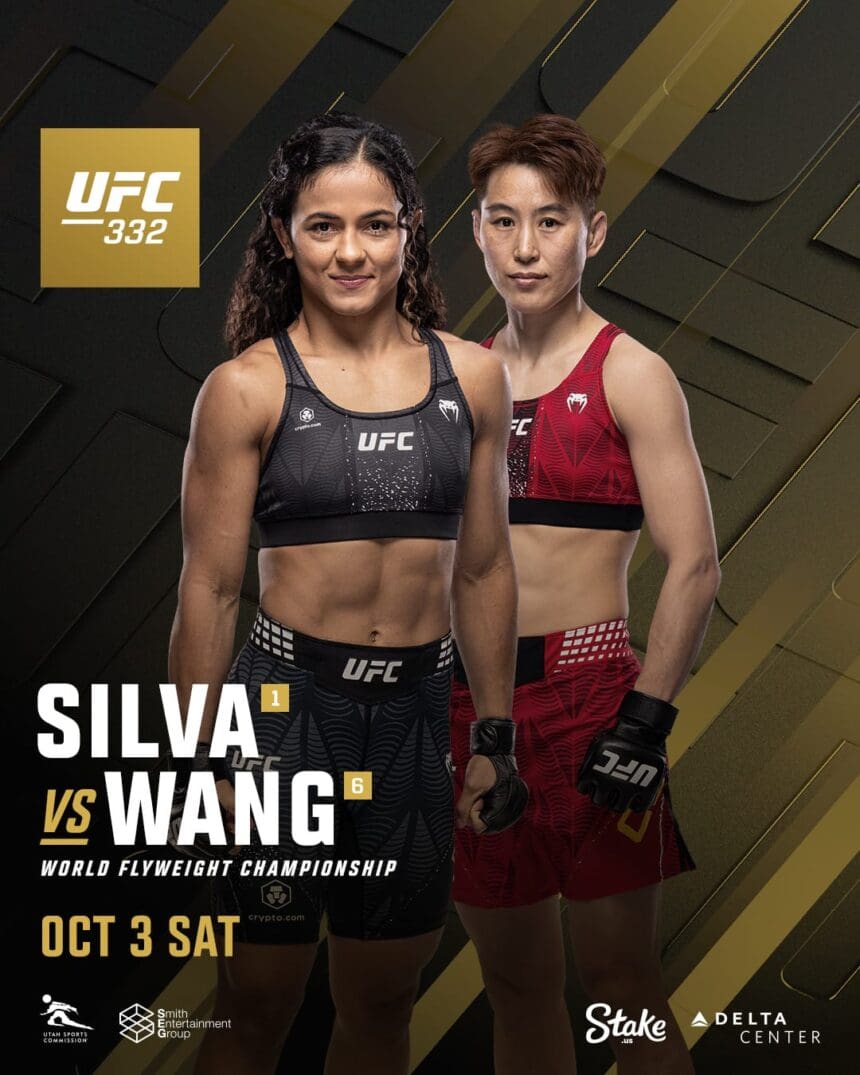
Scheduled for October 3 at the Delta Center in Salt Lake City, UFC 332 will be headlined by Natalia Silva vs. Wang Cong for the vacant UFC flyweight title. The matchup came together after a last-minute shake-up when Valentina Shevchenko suffered a ligament injury to her back that is expected to sideline her for up to a year, forcing the UFC to strip her of the title.
Since the announcement, fans have taken to social media to voice their frustration over the card’s lack of star power and underwhelming supporting lineup. Many have already labeled Silva vs. Wang one of the weakest UFC main events in recent memory. The criticism becomes even more understandable given that UFC 332 is sandwiched between UFC 331 and UFC 333, two cards that promise considerably more firepower. For fans who treat their entertainment spending like choosing a legit online casino, UFC 332 may feel like a questionable bet.
UFC 332 Gets Sandwiched Between Two Banger-Numbered Events
UFC 331 is set for September 19 and comes with a big-time rematch for the men’s flyweight title, as Alexandre Pantoja challenges Joshua Van for the gold. The co-main event isn’t too shabby either, with Arman Tsarukyan taking on Mauricio Ruffy in a high-stakes lightweight clash that could put the winner in line for a shot at Justin Gaethje and the 155-pound title.
Then there’s UFC 333. Alexandre Volkanovski will return to defend his featherweight title against Movsar Evloev in the main event, while the co-main features a heated trilogy fight between Merab Dvalishvili and Petr Yan for the bantamweight championship. Put those matchups next to Natalia Silva vs. Wang Cong, and the difference in star power is pretty obvious.
View this post on Instagram
ALSO READ: Tom Aspinall Vacates UFC Heavyweight Championship After Further Right Eye Damage
That isn’t to say Silva and Cong aren’t legit fighters. Silva is riding a perfect 8-0 record inside the Octagon and has established herself as one of the division’s top contenders. The issue is simply that neither woman has the name recognition of the stars headlining UFC 331 and UFC 333.
The UFC reportedly tried to put together an interim light heavyweight title fight between Jiri Prochazka and Paulo Costa, but those plans ultimately fell apart. Before that, the company had reportedly planned for Valentina Shevchenko to face Silva, with the matchup later being elevated to the main event. Unfortunately, Shevchenko’s injury forced her to vacate the title, leaving the UFC scrambling and ultimately creating the Silva vs. Cong matchup.
The rest of UFC 332 doesn’t exactly scream blockbuster either. Former bantamweight champion Deiveson Figueiredo will take on Payton Talbott in the co-main event, with both men hovering around the back end of the Top 10. Ateba Gautier, Damian Pinas and Imanol Rodriguez are also set to compete, while longtime light heavyweight contender Johnny Walker will make his UFC heavyweight debut against Mick Parkin.
There is at least one fight that could give the card some much-needed juice. Roberto Soldic will finally make his Octagon debut against Khao Williams at 170 pounds. The former KSW champion arrives with plenty of hype, especially after his memorable 2018 knockout win over Dricus Du Plessis.
So, could UFC 332 turn into one of those sleeper cards that looks underwhelming on paper but delivers once the cage door closes? Absolutely. It may lack the star power of UFC 331 and UFC 333, but there is still enough talent on the card to produce some fireworks.
That said, calling Silva vs. Cong one of the weakest UFC main events ever is a pretty big claim. So, is it actually the worst main event in UFC history? Let’s take a look at some of the competition.
Where Does UFC 332’s Main Event Rank Among the UFC’s Worst Ever?
When talking about the worst main events in UFC history, a few fights immediately come to mind. Israel Adesanya vs. Yoel Romero at UFC 248 and Dave Menne vs. Caol Uno at UFC 33 are obvious candidates. But where does UFC 332’s Natalia Silva vs. Wang Cong fit into that conversation? Before making that call, let’s look at some of the other questionable headliners the UFC has given fans over the years.
1. Anderson Silva vs. Travis Lutter (UFC 67)
Fans were already buzzing after Anderson Silva stormed into the UFC, destroying Chris Leben before taking the middleweight title from Rich Franklin. Then came The Ultimate Fighter Season 4, which featured comeback fighters instead of prospects, with the winners earning title shots. Matt Serra won the welterweight tournament and shocked the world when he dethroned Georges St-Pierre to win the 170lbs gold.
However, a moment of that magnitude failed to transpire when Travis Lutter emerged as the middleweight winner. Lutter was supposed to challenge Silva at UFC 67, but there was one huge problem: he missed weight. That meant the title was no longer on the line, leaving fans with a non-title fight between Silva and a fighter who was just 1-2 in the UFC before winning TUF.
With Serra’s title fight against St-Pierre also scrapped because of an injury and moved to UFC 69 in April 2007, UFC 67 lost even more star power. Silva eventually submitted Lutter in the second round in a low-stakes and meaningless headliner.
2. Andrei Arlovski vs. Justin Eilers (UFC 53)
UFC 52 was a massive night for the promotion, featuring Chuck Liddell vs. Randy Couture and riding the wave of TUF Season 1. UFC 53, however, was a completely different story. Andrei Arlovski was the interim heavyweight champion after beating Tim Sylvia, while undisputed champion Frank Mir remained sidelined following his motorcycle accident.
Arlovski was originally supposed to face Mirko Cro Cop in Japan, but sponsorship problems killed that plan. Former champion Ricco Rodriguez was then booked against Arlovski, only to withdraw because of issues in camp. That left Justin Eilers, who was just 1-1 in the UFC and had been knocked out by Paul Buentello at UFC 51.
Buentello wasn’t medically cleared in time, so Eilers got the call. Arlovski stopped him in the first round, and UFC 53 reportedly drew just 90,000 buys.
3. Amanda Nunes vs. Raquel Pennington (UFC 224)
This one was largely a victim of the UFC’s messy matchmaking around UFC 222. The promotion initially wanted Amanda Nunes vs. Cris Cyborg at UFC 224, a massive fight that eventually happened at UFC 232.
With Cyborg booked at the aforementioned UFC 222 against Yana Santos, Nunes still needed an opponent. Raquel Pennington was a deserving challenger, riding a four-fight winning streak and coming off a win over former champion Miesha Tate.
The matchup itself made sense. The problem was that it didn’t have enough star power to carry an entire pay-per-view. Nunes vs. Pennington became the card’s only title fight and its main event. Nunes dominated before finishing Pennington in the fifth round, but UFC 224 reportedly did just 85,000 buys, which is the lowest buy-rate for a modern UFC card that did not suffer the effects of the dark age of the early 2000s.
4. Holly Holm vs. Germaine de Randamie (UFC 208)
2016 was an insane year for the UFC. Conor McGregor fought Nate Diaz twice, became a two-division champion at UFC 205, Brock Lesnar returned at UFC 200, Ronda Rousey came back, and the UFC was sold to WME-IMG for $4 billion.
So how do you follow all that? Holly Holm vs. Germaine de Randamie for the inaugural women’s featherweight title. UFC 208 was originally planned for Anaheim, but the promotion struggled to find a suitable headliner and scrapped the January event. Max Holloway vs. Jose Aldo was initially considered, but Holloway needed more time after fighting Anthony Pettis at UFC 206.
Cris Cyborg was also unavailable due to her USADA situation. Holm was coming off two straight losses, while de Randamie had never headlined a UFC event. Fans weren’t exactly thrilled with the matchup, and unfortunately, the fight itself didn’t do much to change their minds.
To make matters worse, the bout ended in controversy, with de Randamie landing hard punches after the bell at the end of both the second and third rounds. Despite the repeated late shots, the referee chose not to deduct a point, adding even more fuel to the criticism surrounding the fight.
5. Demetrious Johnson vs. Chris Cariaso (UFC 178)
During Demetrious Johnson’s incredible run of 13 straight UFC flyweight title defenses, he headlined only four pay-per-views. Those events averaged around 140,000 buys, which is pretty rough by UFC standards.
To be fair, John Dodson, Kyoji Horiguchi and Ali Bagautinov were all interesting challengers. Chris Cariaso, however, didn’t generate nearly the same excitement. Cariaso was a solid fighter, but he had already lost to Michael McDonald, John Moraga, and Jussier Formiga. His biggest win was arguably Takeya Mizugaki, and he earned his title shot by beating Louis Smolka, who had only one UFC fight at the time.
The UFC clearly knew the main event needed help, so they stacked the rest of UFC 178 with Donald Cerrone vs. Eddie Alvarez, Dustin Poirier vs. Conor McGregor, Dominick Cruz’s return, and Cat Zingano vs. Amanda Nunes. Despite all that, the event did just 205,000 buys. Pretty wild when you look at how many future stars were on that card.
6. Rich Franklin vs. Yushin Okami (UFC 72)
Let’s go all the way back to 2007. The UFC was heading to Belfast for its first event there, and the promotion decided to make it a numbered pay-per-view. Randy Couture defending the heavyweight title? Too big. Sean Sherk defending the lightweight title? Also too big. After Martin Kampmann was forced out, the UFC settled on Rich Franklin vs. Yushin Okami.
Franklin was a former 185lbs champion, while Okami entered on a four-fight UFC winning streak and was fighting in a title eliminator. So, technically, it was a meaningful fight. The problem was that UFC 72 aired on tape delay. Fans could literally know the result before they had the chance to buy the event.
Unsurprisingly, it did just 200,000 buys. The UFC quickly learned that fans weren’t interested in paying PPV prices for relatively low-profile European cards they had already seen spoilers for. Most of the other UK and German numbered events from this era eventually moved to Spike TV. Franklin vs. Okami was a good fight. But as a PPV headliner? Yeah, probably not.
7- Max Holloway vs. Conor McGregor 2 (UFC 329)
Conor McGregor’s long-awaited return after his 2021 leg injury came with massive expectations. Whenever McGregor headlines, the UFC knows it has a guaranteed blockbuster, and UFC 329 was no different. But the matchup itself raised plenty of eyebrows.
Max Holloway is an all-time great and one of the biggest stars in the sport, but having him jump to welterweight for a rematch with McGregor felt more like a spectacle than a natural matchup. The UFC clearly tried to give fans plenty of reasons to tune in, stacking the card with Paddy Pimblett vs. Benoît Saint Denis, Cory Sandhagen vs. Mario Bautista, Robert Whittaker’s light heavyweight debut against Nikita Krylov, and Gable Steveson’s promotional debut.
View this post on Instagram
Unfortunately, the main event lasted just 69 seconds. McGregor injured his knee after a flying kick, forcing a TKO stoppage and turning a massively hyped comeback into an instant anticlimax.
So, Where Does UFC 332 Rank?
That brings us back to Natalia Silva vs. Wang Cong. Is it a blockbuster? Absolutely not. The fight lacks the star power of the headliners surrounding it, and the UFC 332 lineup doesn’t exactly jump off the page either.
But calling it one of the worst main events in UFC history might be going a little too far. Silva is undefeated inside the Octagon, Cong is a legitimate contender, and the vacant flyweight title is on the line.
There’s also a chance the fight itself delivers and turns UFC 332 into one of those cards that looks underwhelming on paper but ends up being a sleeper banger. So, is Silva vs. Cong a weak UFC main event? Sure. One of the worst ever? Not even close.

Kshitiz Kumar Singh is a UFC Writer at NY Fights with over three years of experience in sports journalism and content creation. Known for his sharp storytelling and passion for combat sports, he has written in-depth features on stars like Brock Lesnar, Randy Couture, and Ilia Topuria. Before joining NY Fights, Kshitiz worked as a UFC Editor at EssentiallySports while currently serving as a WWE Editor at FirstSportz. His admiration for legends like Georges St-Pierre continues to inspire his detailed and engaging MMA coverage. Whether he’s covering the Octagon or the squared circle, Kshitiz is committed to delivering accurate, high-quality content. Outside the world of sports, he’s a dedicated cinephile, often found practicing monologues from his favorite Al Pacino films, combining his love for cinema with storytelling.