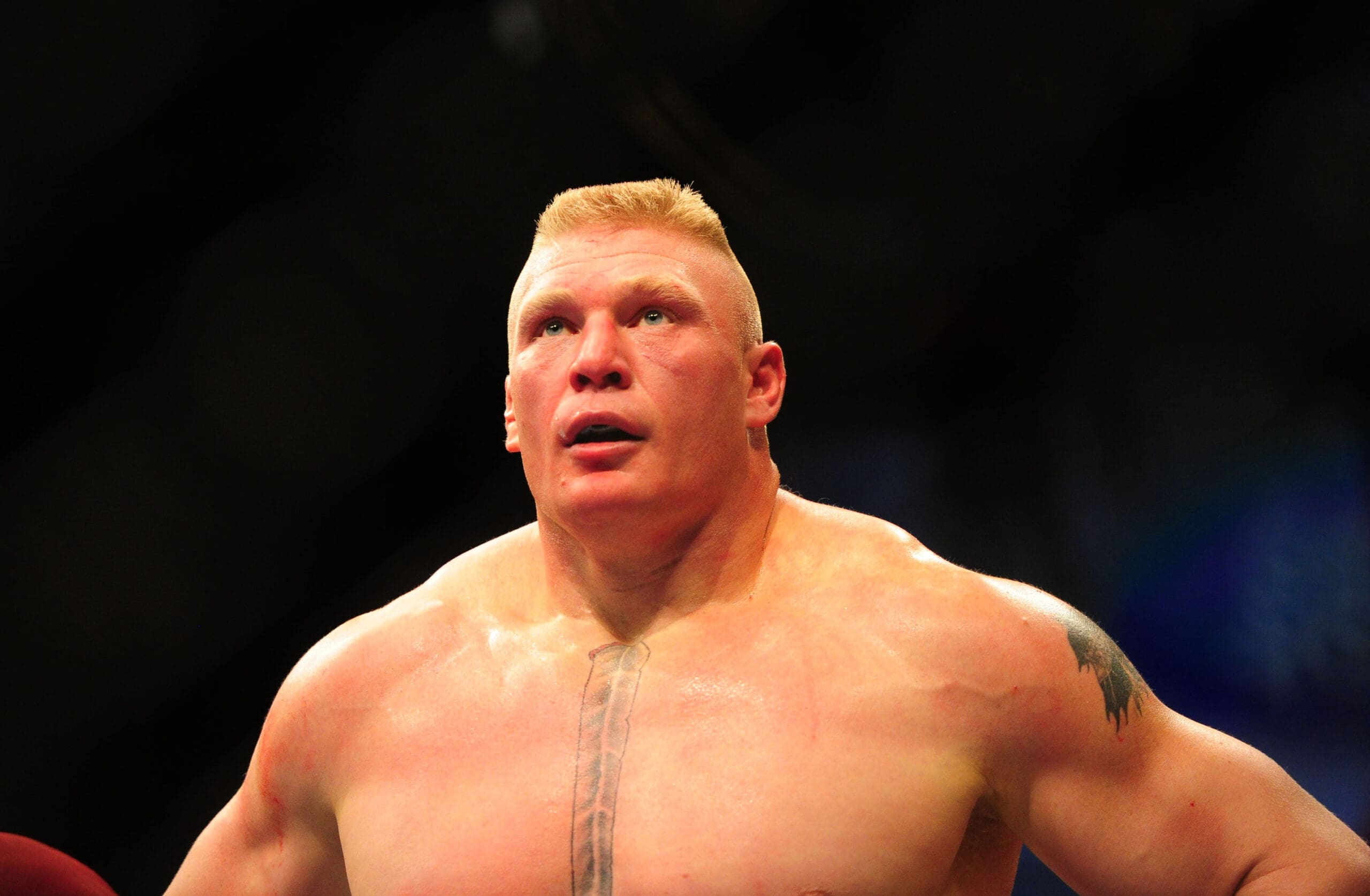
In the mid-2010s, the UFC’s surge into mainstream dominance was driven by megastars like Conor McGregor and Ronda Rousey, who helped usher the promotion into its golden era. McGregor’s crossover appeal, in particular, played a pivotal role in the company’s landmark $4 billion sale to WME-IMG. Yet, amid all the spotlight on these icons, many fans overlook a key figure who helped lay the foundation for that boom: Brock Lesnar.
Lesnar’s drawing power was extraordinary. Five of his fights reportedly surpassed the one-million pay-per-view mark, cementing his place among the biggest stars in UFC history. His rematch against Frank Mir at UFC 100 generated an estimated 1.6 million PPV buys, a record that stood for seven years until UFC 202, headlined by McGregor and Nate Diaz.
More importantly, Lesnar brought with him a built-in audience from professional wrestling, something the UFC had long struggled to tap into. Millions of WWE fans, many of whom had never watched a legitimate MMA bout, tuned in to see whether ‘The Next Big Thing’ could truly fight. And when Lesnar captured the heavyweight title in just his fourth professional bout by defeating Randy Couture at UFC 91, it became a defining moment.
It validated him as more than just a spectacle, drawing widespread attention from major outlets like ESPN and Sports Illustrated and pushing the UFC further into the mainstream. What makes this story even more remarkable is that Dana White initially had no interest in signing Lesnar. Speaking on the Spittin’ Chiclets podcast, Lesnar revealed, “Dana White wanted nothing to do with me. He wouldn’t return my phone call.”
Brock Lesnar talks getting a deal with the UFC and how Dana White wanted nothing to do with him at first.
Full podcast here:https://t.co/87F6B0qAbT pic.twitter.com/oTTU7JFROP
— Jed I. Goodman © (@jedigoodman) March 24, 2026
ALSO READ: Alex Pereira Pays Tribute to Israel Adesanya Ahead of Crucial UFC Seattle Showdown
At the time, the hesitation was understandable. The UFC was still working to shed lingering stigma and establish itself as a legitimate sport. Bringing in a WWE superstar, especially one with just a single professional MMA bout from a K-1 event that failed to make an impact, didn’t align with that vision.
Undeterred, Lesnar took matters into his own hands. In 2007, he purchased four nosebleed tickets to UFC 74, determined to get closer to the promotion he believed he belonged in. He explained, “So what happened was I fought at the LA Coliseum for K-1 Dynamite. And then I wanted to get into the big leagues. And there was only one big league at the time, it was UFC. So my team reached out and wanted to do something with the UFC.”
Lesnar further revealed that the turning point came immediately after the main event at UFC 74, where Randy Couture defeated Gabriel Gonzaga. Seizing the moment, Lesnar rushed to White, introduced himself, and boldly asked for a shot, one that ultimately came in the form of a single-fight deal.
He revealed, “So I said, screw it, and I bought four nosebleed tickets to the MGM Grand, where Randy Couture was headlining against Gabriel Gonzaga for the Heavyweight championship. I sat there in the stands through the entire event, and as soon as Randy won that fight, I scaled the security railing, ran to the Octagon, grabbed Dana, and I introduced myself. I said, I’m Brock Lesnar and we went to the back, and he says, well, listen, I’ll give you a shot.”
That opportunity led to his Octagon debut against Frank Mir at UFC 81 in February 2008, but it didn’t go as planned, as he was submitted by Mir in 90 seconds. Reflecting on the loss, he admitted, “I lost that fight against Frank Mir, and I went back to the locker room, and I was like, ‘I screwed it up.”
However, that wasn’t how White saw it. By the time Lesnar returned backstage, the promotion had already registered an impressive estimated 650,000 pay-per-view buys for the event, numbers that immediately changed the conversation.
In Lesnar’s own words, “And then Dana comes in. He’s like, because they know the pay-per-views buys instantly, right? So the numbers must have been really, really good— Dana is like, ‘No, you’re not done.’ And then the next day, we negotiated a real contract.”
At that point, Lesnar himself acknowledged he had little credibility in MMA. His lone prior win came against Min Soo Kim, a fighter who never recorded a professional victory at a K-1 event, before being overwhelmed by a seasoned submission specialist like Mir. It was clear he had everything to prove, both to the UFC brass and to the broader MMA audience.
And prove it he did. Lesnar went on to become one of the biggest stars in history, capturing and defending the heavyweight title twice during his run. Still, it’s remarkable to consider, had he not literally chased down the UFC CEO that night, his entire career inside the Octagon might never have happened.

Kshitiz Kumar Singh is a UFC Writer at NY Fights with over three years of experience in sports journalism and content creation. Known for his sharp storytelling and passion for combat sports, he has written in-depth features on stars like Brock Lesnar, Randy Couture, and Ilia Topuria. Before joining NY Fights, Kshitiz worked as a UFC Editor at EssentiallySports while currently serving as a WWE Editor at FirstSportz. His admiration for legends like Georges St-Pierre continues to inspire his detailed and engaging MMA coverage. Whether he’s covering the Octagon or the squared circle, Kshitiz is committed to delivering accurate, high-quality content. Outside the world of sports, he’s a dedicated cinephile, often found practicing monologues from his favorite Al Pacino films, combining his love for cinema with storytelling.