The Paramount era of MMA officially began with UFC 324, following a massive $7.7 billion, seven-year broadcasting agreement between the UFC and Paramount. Under this landmark deal with TKO Group Holdings, all 13 annual pay-per-view events and roughly 30 Fight Nights are now streamed on Paramount+, with select cards simulcast on CBS. Financially, the agreement guarantees the promotion of a staggering $1.1 billion in annual revenue, before factoring in ticket sales, sponsorships, and other income streams.
Yet despite this financial boom, the long-standing issue of fighter compensation continues to cast a shadow over the sport. The latest flashpoint involves Jon Jones, who reportedly sought a $30 million payday to unify the heavyweight titles against Tom Aspinall last year. At the same time, negotiations for a potential showdown with Alex Pereira at the proposed Freedom 250 card appear stalled, with the UFC reluctant to exceed a $15 million purse.
This hesitancy stands in stark contrast to boxing, where even less globally established names can command massive payouts. Conor Benn earned $15 million for his bout with Regis Prograis under a TKO-backed partnership, a fight that saw massive engagement across boxing betting sites and international markets. Crucially, Benn retains free-agent flexibility after his one-fight deal, a privilege UFC fighters like Jones do not enjoy. Alternative opportunities are also beginning to reshape the landscape.
ALSO READ: Jon Jones Responds to Albuquerque Road Rage Allegations with His Version of Events
Jake Paul’s Most Valuable Promotions is venturing into MMA, assembling a debut card featuring high-profile former UFC stars such as Francis Ngannou, Ronda Rousey, and Nate Diaz. While some of Rousey’s criticisms of the UFC leading up to the May 16th event may carry promotional flair, her assertion that the organization is among the toughest places for fighters to earn elite-level income reflects a deeper reality. That reality became undeniable when Ngannou left the UFC in 2023, choosing financial freedom and crossover opportunities.
He reportedly earned close to $10 million for his boxing debut against Tyson Fury, a staggering jump from the $600,000 base purse he received as the reigning UFC heavyweight champion. Similar financial realities shaped negotiations involving Ronda Rousey and Nate Diaz, both of whom ultimately pursued more lucrative opportunities outside the promotion. Notably, the financial scale of these deals was even acknowledged by Dana White himself in separate press conferences following the official announcements.
A glance through history makes it clear that this tension is nothing new. Time and again, disputes over pay have surfaced at the highest levels of the sport. With that in mind, here are some notable instances in UFC history where the promotion refused to bend to meet the financial demands of its biggest stars.
1- The Dark Ages and the Japanese Gold Rush
During the late 1990s “Dark Age” under SEG ownership, the UFC was financially unstable, banned from major cable platforms, and hemorrhaging talent. Fighters like Mark Kerr were lured away by lucrative offers from Japan’s Pride Fighting Championships, deals the UFC simply could not match. In fact, the promotion resorted to legal action to prevent Kerr’s exit, forcing him to buy out his own contract.
The era also saw the first major fallout with Randy Couture. After winning the heavyweight title from Maurice Smith, Couture was told by management that the promotion simply couldn’t honor his contracted pay. When Couture insisted on the agreed terms, the UFC stripped him of his title.
This established a dangerous precedent: the promotion would rather vacate a championship than yield to a fighter’s financial demands. It naturally resulted in a mass migration of talent, including Mark Coleman, Dan Henderson, and Vitor Belfort, all of whom found far greater financial rewards in Japan.
2- The Zuffa Lockdown: Clauses and Coercion
Even after Zuffa acquired the UFC in 2001, the promotion prioritized brand-building over athlete compensation. The company’s first-ever 155lbs kingpin, Jens Pulver, left after being denied even marginal pay increases, reinforcing the notion that the UFC brand was valued above the fighters themselves.
No case better encapsulates this dynamic than the second doomed saga of Randy Couture. After a successful run and brief retirement, Couture returned amid promises of a lucrative superfight against Fedor Emelianenko. When those promises fell through, and as newcomers like Brock Lesnar began earning more, Couture publicly resigned while still champion, triggering a fierce legal battle.

The UFC argued he had retired, allowing them to freeze his contract and block outside opportunities, including commentary work with HDNet. Ultimately, Couture was forced to return under revised terms, only to suffer a decisive loss to Lesnar at UFC 91. The episode cemented a critical lesson for the promotion: contractual control could be leveraged as effectively as any business strategy.
Another example of an early dispute with Murilo Bustamante in 2002 exposed a critical vulnerability: champions could potentially fight out their contracts and walk away. The solution was the now-infamous “Champions Clause,” a contractual mechanism that automatically extends a fighter’s deal, typically by three fights or one year, each time they defend or win a title. In practice, this meant that sustained success effectively trapped fighters in place.
The first major test came from B.J. Penn, who signed with K-1 in Japan after capturing UFC gold. The company responded with legal action, claiming breach of contract. While the case never reached a definitive courtroom conclusion, it sent a clear message: leaving the promotion, even as a champion, would come at a steep cost.
Beyond contractual extensions, Zuffa also weaponized matchmaking and titles. When Tito Ortiz held out for better pay following the massive success of UFC 40, the promotion introduced an interim title to apply pressure. The tactic worked as Ortiz eventually returned, but under less favorable financial terms.
By the late 2000s, the system had tightened further. In 2008, Jon Fitch was briefly cut from the roster for refusing to sign over lifetime likeness rights. Though he was reinstated, the episode underscored the promotion’s stance: fighters were independent contractors in name, but with limited negotiating power in reality.
3- The Reebok Deal and the Antitrust Awakening
If contractual clauses limited mobility, the 2014 partnership with Reebok reshaped fighter income entirely. Before the deal, even mid-tier fighters could earn significant money through independent sponsorships displayed inside the cage. That ecosystem was effectively dismantled overnight, as Reebok became the exclusive outfitter and all external branding was banned.
While the UFC publicly downplayed its financial gain, the new structure centralized control. Fighters were now paid a fixed sponsorship scale, starting as low as $2,500 for newcomers, which was far below previous open-market earnings. The backlash was immediate and intense.
This led to a landmark $1.6 billion antitrust lawsuit spearheaded by fighters like Cung Le and Nate Quarry. During discovery, previously private financial data revealed a stark imbalance: fighters were receiving roughly 18% of total revenue, compared to near 50% splits in leagues like the NBA and NFL.
Though the case ultimately settled for $375 million last year, it failed to bring structural reform. The UFC successfully defended its practices as aggressive competition rather than monopolistic behavior. By this stage, the promotion had transformed into a talent-proof enterprise, where the brand itself carried more weight than any individual athlete.
4- The Modern Frontier: Francis Ngannou’s Gambit and What Lies Ahead
Under Endeavor Group Holdings and TKO Group Holdings, the approach has shifted from overt legal battles to strategic inactivity, often referred to as freezing out fighters. The modern version of leverage is simple: accept the terms, or risk long periods without fights or income.
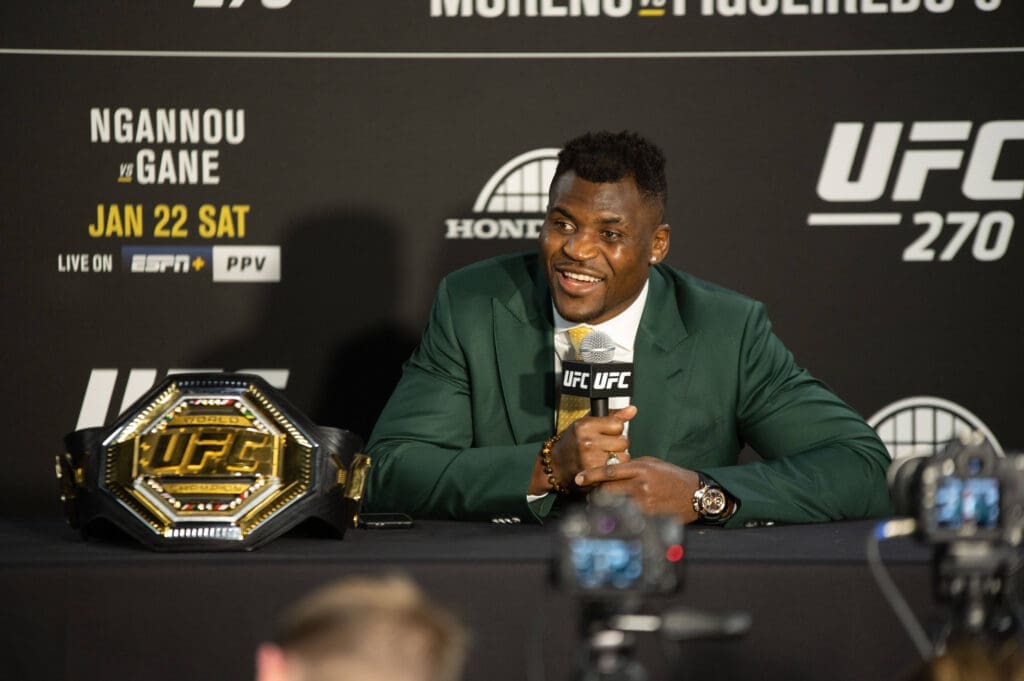
Most fighters still face what’s informally known as the Ngannou dilemma: sign a long-term deal to secure title opportunities, or risk being sidelined. But Francis Ngannou managed to break the cycle. By capitalizing on a temporary sunset clause inserted during the antitrust scrutiny, he waited out his contract and rejected a lucrative offer that lacked boxing freedom and financial guarantees.
The gamble paid off. Ngannou went on to earn tens of millions in boxing, including a high-profile bouts with Tyson Fury and Anthony Joshua. In response, the UFC quickly tightened contractual language, closing that pathway for future fighters. Today, even established names like Jorge Masvidal and Colby Covington have acknowledged the persistence of a take-it-or-leave-it culture. Fighters who decline bouts over pay disputes can find themselves inactive for extended periods, with limited recourse.
Meanwhile, stars such as Jon Jones continue to push for greater financial freedom, and Conor McGregor has publicly criticized the erosion of the traditional PPV model. Yet, meaningful collective action remains elusive. The sport’s biggest earners often operate independently, while lower-tier fighters lack the leverage to challenge the system.
Moreover, the underlying business fundamentals of TKO Group Holdings highlight just how lucrative the model has become. The company reported $1.04 billion in revenue for Q4 alone, alongside an adjusted EBITDA of $281.2 million. According to The Hollywood Reporter, the more revealing insight lies in TKO’s forward guidance for 2026, which projects a significant financial leap.
The company is targeting total revenues between $5.675 billion and $5.775 billion, up sharply from $4.375 billion in 2025, while adjusted EBITDA is set to rise to between $2.240 billion and $2.290 billion, compared to $1.585 billion the previous year.
Within that framework, the UFC continues to be a major driver of growth. Its revenue for Q4 climbed 17% to $401.4 million, fueled largely by increased partnerships and marketing deals, while adjusted EBITDA rose 20% to $213.2 million. These numbers underscore a promotion operating at peak commercial efficiency in the modern era.
Yet, despite this financial surge, the issue of fighter compensation remains unresolved, even for the sport’s biggest stars. The debate is not new, as it predates the current streaming era and stretches back to the days when the UFC was built on the traditional pay-per-view model. What has changed is the scale of the revenue, not necessarily how it is distributed.
The result is a cycle that has proven remarkably resilient. Over decades, the promotion has engineered a system where control and brand dominance outweigh individual bargaining power. Fighters come and go, champions rise and fall, but the underlying economics remain largely untouched.

Kshitiz Kumar Singh is a UFC Writer at NY Fights with over three years of experience in sports journalism and content creation. Known for his sharp storytelling and passion for combat sports, he has written in-depth features on stars like Brock Lesnar, Randy Couture, and Ilia Topuria. Before joining NY Fights, Kshitiz worked as a UFC Editor at EssentiallySports while currently serving as a WWE Editor at FirstSportz. His admiration for legends like Georges St-Pierre continues to inspire his detailed and engaging MMA coverage. Whether he’s covering the Octagon or the squared circle, Kshitiz is committed to delivering accurate, high-quality content. Outside the world of sports, he’s a dedicated cinephile, often found practicing monologues from his favorite Al Pacino films, combining his love for cinema with storytelling.